Monday, April 30, 2012

Answers in Pandeism: 'Converting' to Pandeism

I was asked not long ago by a person of a different faith:

If I convert, what is some advice for beginning the conversion from [insert religion here] to Pandeism?
"Conversion" here is, I think, an imprecise word. From the perspective of one vested in religious terminology, it is easy to think in terms of "converting" from Christianity to Judaism, from Islam to Hinduism, even from some theistic belief to 'Fundamentalist' Atheism (the absolute certitude that there can be no metaphysical characteristic of our Universe). And indeed, there is some amusement inherent in the constant efforts of certain die-hard Catholics and Protestants (even Mormons) to "convert" each other to "Christianity."

But Pandeism, based as it is on probabalistic logic, is inherently a more agnostic point of view. It is the view not that this is how things are, but that this is the most probable state of theological affairs, based on the determination of what is absolutely necessary, the elimination of what is impossible, and the assignment of comparative levels of probability to everything which remains. One becomes a Christian or a Muslim by declaring certainty in its doctrines and forsaking the possibility of their falsity or errancy. One does not become a Christian by announcing the belief that "maybe it is possible that Jesus could have been resurrected"; one does not join Islam by determining that "the possibilities that Mohammad was or was not a prophet are in equipoise." To become a Pandeist is thusly more like choosing to become a critical thinker, a demander of proof and of the weighing of probabilities (and not only proof for propositions such as "there is a god" but for counterpropositions such as "there are no gods" or even "there can not be any gods").

Note as well that the pandeistic position is one which has independently been arrived at, at several historical times and places, by people who had never heard of each other's work, and even used completely different terminology to describe what is, on examination, the exact same concept. This is, then, a fundamentally universal theological model, able to be discerned by anybody who possesses the right combination of analytical ability, intellectual openmindedness, and general scientific knowledge. Contrarily, no person has ever come to discern any doctrine of any revelational faith without first being told of that faith by somebody else. Nobody ever decided (so far as has been reliably recorded) to become a Christian or a Muslim or a Mormon without first being told about it by somebody who already knew of (and probably adhered to) that faith. But, as few Pandeists as there have been, they have been as like as not to figure it out for themselves solely by strict examination of the characteristics of the world around them. (And indeed, more than one person I've met had arrived at the conception, and were pleasantly surprised to find that it has a formal name -- and a community of adherents!!)

Remember that Pandeism arises from the application of logic and reason, and sharply applies the principle of parsimony (which is, the belief that where an event may be accounted for by explanation with fewer assumptions, then there is no basis to accept any additional assumptions). There is without doubt some challenge for one who takes Pandeism seriously, and to its logical conclusion; for once we recognize that all things are part of our Creator, and all experiences are shared with our Creator, we must act in accord with that belief. Now, if you wish to start down this path, there is some bit of reading I would recommend:

* The God Theory and The Purpose-Driven Universe by Bernard Haisch
* Rationalist Spirituality by Bernardo Kastrup
* The God Franchise by Alan Dawe
* The Mind of God by Paul Davies
* The Pandeist Theorem (in A Theorem Concerning God) by Robert G. Brown
* God's Debris by Scott Adams
* Our Goal Is God: A Guide to Spiritual Awakening by H. Thomas Miller

One thing you might observe about these authors is that many of them have Ph.D.'s in physics or astrophysics or other 'hard science' fields. These are not lightweight thinkers, nor are they people easily inclined to accept an explanation on somebody else's sayso. Another, perhaps more obvious point is that almost all of these titles refer to 'God,' a term beset with the baggage of theisms past, unfortunately still often required to telegraph the ultimateness of the concepts to be conveyed. But there are gems of thought within these books which well-inform any seeker after truth!!

Sunday, April 15, 2012

Pandeism vs Theism: The Unevangelised

Pandeism vs Theism: The Unevangelised -- an old vid but one making a singularly poignant point.

Wednesday, April 04, 2012

Pandeism Fully Accounts


I have posted this before, but it's so far buried in past posts that I thought I'd simply bring it to the fore once again....

Monday, April 02, 2012

Gödel's incompleteness theorem and "God"

There is one proposition which no deity possessed of godlike powers would ever be able to know the truth of, and that is whether it itself is simply a construct within an even greater reality beyond its perception. This may sound odd and impossible, but let us think this through. First, imagine a point in space. Now imagine that a straight line begins at that point and extends infinitely onward in one direction from that point. Flat space, please, don't want that line curving around and becoming itself. Now imagine a second point right next to the first, with a parallel infinite line extending infinitely outward in one direction. So now you've got infinite nonintersecting lines. If either line could be aware of its own infinitude, it might imagine itself to be the only thing in existence capable of being infinite. Now, let us take the second infinite line and move its starting point backwards an inch relative to the other line. Now you have two infinite lines, but one is an inch longer than the other.

Now let's take that longer line and stretch it along a second dimension, making it a flat plane with a few inches of height (and still infinite length). We keep it parallel to our first line, so they still never intersect; the first line still has every reason to believe itself to be uniquely infinite, even though it is right next to a thing that is not only an inch longer, but has an entire additional dimension of substance. And now we will take the second object (which is now a plane) and curve it into a cylinder which completely surrounds the first line, but continues never touching it. And just for the sake of it, we'll take that end of the cylinder that goes past the first point and curve its edges toward one another, into a sort of hemispherical cap which closes off that end of the cylinder (still without touching the original infinite line). Indeed we could do all of these operations to the first line and make into an infinitely long tube with one end beginning with a hemisphere, and still have it completely contained within a slightly larger tube with which it never intersects.

Now you might at this point be thinking, 'yes but the gods envisioned by human faiths are not mathematical constructs, they are not tubes; so what's the point?' Well, you would be correct that man-described deities tend not to be mathematical constructs, but human ideas of the ultimate are necessarily constructs nonetheless, for they are invariably described in human languages, and with human words and concepts such as 'infinite' and 'absolute' (and really those are concepts which, if not outright mathematical, are subject to mathematical discussion). Lest we delve too close to describing perfectly spherical gods in a vacuum, let us get straight to the heart of the capacities philosophically ascribed to deity-models. Able to do anything; possessed of all knowledge. But wait, there's the catch. No matter how much knowledge a god possesses, it is impossible for it to know that it is not missing some knowledge of which it is unaware, such as the existence of a greater surrounding entity which contains it. It's like this....

Remember Neo, in The Matrix; once the nature of the Matrix was revealed to him, he found that while outside of it he was a normal human, but inside of it he had, essentially, superpowers. But how could Neo outside the Matrix know he was really outside the Matrix? After all, though things smelled and tasted and felt different, all of that could simply be another trick of the computer, sending signals which let Neo to think that he was experiencing those differences. Naturally, the lack of superpowers in the 'real' world (and existence of superpowers in the 'false' world) would be trivially easy to conjure up through the signals sent to Neo's brain (if he has a 'brain' at all, for Neo's entire existence could be as a subroutine within a larger program, one programmed to believe itself to be an independent organic entity). And no amount of contemplation would then allow him to peel back the falsity of the 'real' world outside the one he already knew to be false. But suppose instead of being programmed to believe himself to be a superpowered human, Neo was programmed to believe himself to be an omnipotent/omniscient deity? Anything which he wished to bring about would instantly present itself to him as having transpired; any knowledge he wished to have would instantly manifest itself in his mind. If he wished to set forth living planets orbiting burning stars to fill hundreds of trillions of galaxies, and know the every movement past and future of every atom in them, he could (if sustained within a powerful enough system) do so with a thought. But none of this would prove that it was Neo's inherent godliness causing such things to come about, for it could always be an even greater being, an imperceptibly nonintersecting surrounding cylinder of a being, providing all of these experiences.

Even if in some relative sense the Bible or the Qu'ran or the Baghavad Gita were true (such that there was a Creator entity which set forth all that we humans are able to perceive at least, and all the events recounted transpired as set forth there), even this Creator entity could never know that everything it was doing was not part of some infinitely greater Creator-entity's thought experiment. (Here is an inverse proof of this -- imagine a true all-powerful being not sustained within anything greater than itself; such a being could, by definition, create a slightly lesser being which believed itself to be the true 'only all-powerful being,' and which would by dint of the true all-powerful being's all-powerfulness, be absolutely unable to detect the greater being of which it was part).

And if no hypothetical Creator of our entire Universe could possibly actually know whether it was the ultimate being, then surely we spatially and temporally and intellectually limited humans can have no inkling as to what the truth is of such a thing. And here's the even greater rub; supposing that there was a god of this or that scriptural type, and that this god was unknowingly simply an entity sustained in existence within a greater being (and perhaps one of many so sustained), then the greater being within which it was sustained would itself have no way to be sure that it wasn't merely the thought experiment or subroutine or what have you of an even greater thing than itself, a cylinder within the cylinder, within perhaps inestimable layers like a neverending Russian doll. And that is why Godel's theorem makes it impossible for there to be an absolutely omniscient deity. (Which is by the way of no concern to Pandeism, which never proposes absolute omniscience anyway, but only ever proposes such relative omniscience as would be required to account for our finite Universe so far as we are able to perceive it.)

Sunday, March 25, 2012

Answers in Pandeism: Part IV: Looking Back to Christian Deism

As I have mentioned in past posts, a while back I received this email:

Hello,

I am a 17 year-old that has been thinking about becoming a Pandeist for the past few days. Currently, I am a Christian and come from a background of Christians. I have read a lot on Pandeism recently and have a basic understanding of it. I share a lot of similar beliefs, but I just have a few questions:

Do you acknowledge the existence of Jesus?

Do you pray?

What do you do as a Pandeist? Do you congregate (as in a church or synagogue)?

If I change to Pandeism, how should I approach my parents about not being a Christian anymore?

If I convert, what is some advice for beginning the conversion from Christianity to Pandeism?


I have answered some of these questions here before, and today I address this one:

If I change to Pandeism, how should I approach my parents about not being a Christian anymore?

Now that is indeed an interesting question. One thing about Pandeism, it recognizes that we each inhabit our own lives, and so each of us knows ourselves (or is capable of knowing ourselves) better than any person outside ourself can. That is indeed one of the very points of our existence, that we each generate our own unique set of experiences, which we (being a part of our Creator) contribute to the whole of the experience of our Universe. You know your parents, possibly better than anybody else in the world; how will they react to one approach or another? What purpose is served by 'approaching' them at all? And indeed in some sense the question ought to be, if Pandeism presents a more logical and reasonable approach, how can Iteach my parents about my understanding of Pandeism? How can I bring them around to understanding the logic of the position (even if they are perhaps unable to break faith with the psychologically comforting beliefs of their ancestors).

And as to the question of not being a Christian anymore -- well, is that so? Who decides that? I know some who consider themselves Christian Pandeists on the strength of their faith in the correctness of the peace and love and tolerance taught by Jesus, and not at all in mythic aspects such as the virgin birth, or the resurrection tale, or of casting body-possessing evil spirits into pigs. This descends, indeed, quite directly from Christian Deism, a tradition which long ago embraced the values and non-mystical teachings of Jesus. An example, possibly the most famous, wasThomas Jefferson, an avowed Deist who spoke of 'nature's God,' and produced for himself the "Jefferson Bible" -- a Bible from which Jefferson had cut out all reference to revelations and miracles, aspects which he rationally deemed to be later human inventions or incorporations designed only to deify one man, instead of elucidating all men.

No contradiction, no paradox, extends from adopting certain of the values and ideals claimed to have been espoused by Jesus, and yet believing in a deistic theological model. Let us examine this. One of the earliest mentions of Christian Deism dates from 1737, where one Thomas Morgan wrote:

For God, according to these Philosophers, makes and governs a natural World that is capable of governing itself, and that might have made itself as well, had they not pass'd a needless and insignificant Compliment upon, the Creator. But I hope they will mend their Scheme, and compound this Matter for their own Honour, and not pretend to fay, that God has made a necessary World, or a self-existent System of Creatures. Yet this is the philosophical Scheme of Atheism, which its Patrons would fain call Deism, and in which the Christian Jews or Jewish Christians assist them, by joining inadvertently in the fame Cry. But if this be not a fine Scheme of Philosophy, let Christian Deism stand for an odd Sort of Religion, and let the Christian Jews be for ever orthodox, and be allow'd as the only religious Men in the World. It is certain, that if God governs moral Agents at all, he must; govern them by Hope and Fear, or by such a wise and suitable Application of Rewards and Punishments, as the different Circumstances of Persons, and the Ends of Government require. And these Rewards and Punishments must be such as are not the natural, necessary Consequences of the Actions themselves, themselves, since every one must see that this would be no Government at all, and that the Case, in this Respect, must be the very same whether we suppose any rectoral Justice, or any Presence or Operation of God in the World or not. And yet this which is really no Government at all, is all the general Providence which some seem willing to allow. But since those Gentlemen are all deep Philosophers, and above the gross Ignorance of the common Herd, I would here only ask them, What are the Laws of Nature ? What is the Law of Gravity, the Law of communicating Motion from one Body to another by Impulse, and the Law of the Vis -Inertia of Bodies ? Are these natural, essential and inherent Properties of the Bodies themselves, or are they the regular Effects of some universal, extrinsick Cause acting incessantly upon the whole material System, by such and such general Laws and Conditions of Agency?

The moral philosopher: in a dialogue between Philalethes, a Christian deist and Theophanes a Christian Jew. By Thomas Morgan, 189-190, 1737

And then a bare two years later, one John Leland wrote:

This may give the Reader some Notion of this Writer's Candour and Sincerity, and what we are to think of his pretended Regard for Christianity, which in Effect amounts to this: That the Christianity revealed in the Writings of the New Testament is Jewish Christianity; that is, Christianity corrupted and adulterated with Judaism, which according to him is the worst Religion in the World. But the true and genuine Christianity is Christian Deism, to be learned not from the Writings of the New Testament, but from the Volume of Nature, from every Man's own Breast, from the Heavens, the Earth, and especially the Brute Creatures,the genuine uncorrupted Instructors in our Author's Christianity. So that the "Gentlemen that assume to themselves the Title of Deists, seem resolved that for the future they only shall be called the true Christians too. Those that look upon the New Testament to be divinely inspired, and receive it as the Rule of their Faith, and take their Religion from thence, must be called Christian Jews, who only put a strange Mixture of inconsistent Religions upon the World for Christianity : whereas these Christian Deists teach it in its Purity, and in order to propagate pure uncorrupted Christianity they do their utmost to discard.the Writings of the New Testament, that Is, the Writings that give us aft Account of the Doctrines taught by Christ and his Apostles, But since these Gentlemen will not allow; us the honourable Title of Christians, it is but fair that they should leave us that of Free-Thinkers, to which I really think the Advocates for the Gospel Revelation have a much juster Pretension than they.

The divine authority of the Old and New Testament asserted. By John Leland, viii-ix, 1739

Now, firstly I do not mean to at all impugn Judaism by quoting accounts which suggest it to have 'corrupted' Christianity, for really any theistic influence is bound to be just as corrupting of efforts to achieve truth through reason. Consider Buddhism -- the founder of that faith, the Buddha, denied being at all 'divine' and dismissed the idea of the existence of divine beings who were any more in control of their ultimate reality than man. He would have absolutely laughed at the objectively ridiculous idea that bowing to a statue of himself would be thought to bring about luck for people living many centuries later -- and yet this is modernly precisely what many Buddhists do, venerating the man at the expense of the message, and attributing miracles tointervention resulting from prayers to the Buddha. (And, as I have discussed elsewhere, Pandeism accounts for the experience of efficacious prayer.) And it may seem strange as well to those inculcated with theistic traditions to speak of Deism as an 'uncorrupted' Christianity, but some fundamental ideas remain -- the idea that what we do unto our neighbours, even unto 'the least of' our neighbours, we do to our Creator; not that doing bad to our neighbours is simply condemned, but that we are actually doing it to our Creator, that our Creator is physically and emotionally experiencing through us all we do, and all that is done to us.

And so Pandeism leaves room for reverence for a human Jesus, even for Jesus as a sort of naturally occurring divine figure, akin to the Buddha as a mystically gifted product of the rational processes of a rational Universe. And really, it is this view in which Pandeism places a higher veneration on men like Socrates and Jesus, Mencius and the Buddha, and more modern men of holy bearing, such as Gandhi. For it is no great boon to deem a man to be 'God' -- for Pandeism, through logic and reason, explains that all man and all things are equally part of our Creator. It is the knowing of this, and the consequent understanding that we must love and respect each other as the pieces of our Creator we are, which is the most remarkable achievement attainable.

So, taking this back to the original question, are you telling your parents that you are "not being a Christian anymore," or are you telling them that you're simply no longer the kind of Christian who venerates the mythic aspects of ancient books over their metaphorical import? And, to bring this back to one additional level of depth of thought, since Pandeism teaches that we ought to strive to minimize negative experiences in the world (so far as we have control over them) and maximize positive experiences (all such experiences after all being the experiences of our Creator as well), if such a declaration will lead to grief and conflict, why must you tell anybody especially what reason dictates to be your inner beliefs?

Sunday, February 26, 2012

Answers in Pandeism: Part III: What do Pandeists do?

I noted in previous posts having received this email:

Hello,
I am a 17 year-old that has been thinking about becoming a Pandeist for the past few days. Currently, I am a Christian and come from a background of Christians. I have read a lot on Pandeism recently and have a basic understanding of it. I share a lot of similar beliefs, but I just have a few questions:

Do you acknowledge the existence of Jesus?

Do you pray?

What do you do as a Pandeist? Do you congregate (as in a church or synagogue)?

If I change to Pandeism, how should I approach my parents about not being a Christian anymore?

If I convert, what is some advice for beginning the conversion from Christianity to Pandeism?


Today I address the question: What do you do as a Pandeist? Do you congregate (as in a church or synagogue)?

That is actually a quite deep question -- what do we do as Pandeists? So the first thing to consider is the frame of reference which Pandeism generates for all things around us, all people, all life. It is at this point useful to point out some distinctions between different kinds of pandeistic beliefs, as there are some different ideas floating around within Pandeism.

Firstly, there are spiritual Pandeists, such as myself and the Pandeists I know generally, and indeed most Pandeists you will ever encounter on the internet, or in life. We are the Pandeists who believe that logic and reason direct us inevitably towards the conclusion that our Creator became our Universe -- a Universe ingeniously calculated to give rise to complexity, and ultimately to intelligent life -- for the purpose of learning through a shared existence with our Universe.  Because we consider all things to be part of our Creator, which unconsciously underlies our Universe and shares in all aspects of our existence, we weigh our actions towards other people and other living and feeling things accordingly.

Then there are ones who call themselves Scientific Pandeists -- this is really a misnomer, for even the most spiritual of Pandeists would recognize science as the path by which the mechanisms of our Creator are discovered and revealed -- but the handful who use the actual term 'Scientific Pandeist' are more akin to atheists who acknowledge only that all things are connected, and had a time of origination, coming from a single source, but do not necessarily recognize that source as an intelligent designer, as other Pandeists do.

Lastly there are what we would call the radical Pandeists, who follow a model like the one Scott Adams proposed in God's Debris, wherein our Creator essentially committed suicide -- that is, where it completely, and possibly irrevocably, destroyed itself. And, to those who believe as such, our Universe is simply the consequence of that, imbued with life only as an aftereffect of the nature of the Creator.

There are good reasons I would contend why the spiritual Pandeist path is the most logical explanation of the fortuitously life-generating and profoundly experience-generating Universe in which we live, though in my view this amounts to the defense of Pandeism itself. After all, ours seems to be a Universe geared towards the generation of self-advancing sort of intelligent life, hardly the aspects of a wholly dormant or even thoughtlessly suicidal Creator.

Back to the typical and spiritual form of Pandeism, the thing to remember is that by following this path you are acknowledging that all things occur within our Creator; and though it has in becoming our Universe intentionally temporarily sacrificed its own ability to do anything else but experience such existence, it nonetheless does experience all things which occur herein. And so, whatever pain or suffering occurs in the world, our Creator experiences that. And there is a lot of pain and suffering -- but there is a balance, there is as well a great deal of pleasure and happiness. And there's not much of either under the control of each of us as individuals, but we can control our own actions, what we bring to our world. And so it must be remembered that when you cause injury to another person, you are causing that injury to your Creator. When you cause (or allow) injury to yourself, you cause or allow that injury to your Creator, who experiences everything you do. So the Pandeist considers his actions mindfully with regard to the desire to minimize pain and suffering and maximize pleasure, minimize sadness and maximize happiness in the world, as best we are able with the always-incomplete information in our possession.

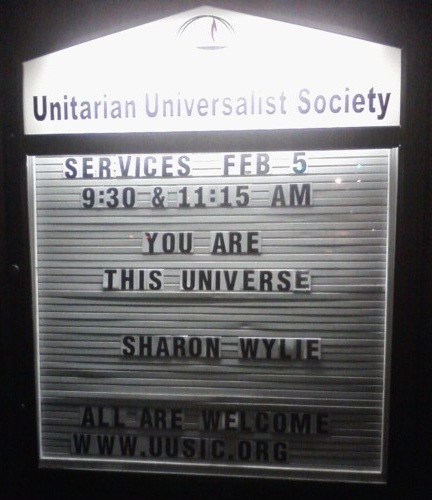
Sign from a Unitarian Universalist meeting
in Iowa addressing a very pandeistic theme
Now, as to congregation, we do not have churches or temples or synagogues.  Some groups of pandeists gather together on occasions special to their particular locality to celebrate the myriad bounties of life. Perhaps at some future point, some group of Pandeists or other will decide to erect a building for spiritual commemorations, but I'd have no great interest in such an effort.  It seems to me that such erections, if that's all they're used for, take up space in a world full of unneeded buildings contrasted against homeless people looking for an unavailable roof over their heads.

The times I've gotten together with others on my wavelength have been in people's homes or in natural spaces, or in the many other public places where a group of friends can gather and speak at their leisure. Pandeists often have a great deal in common with Deists and Universal Unitarians, so we who are Pandeists may seek out the activities of these groups. I used to get together with some fellow Pandeists in my area for a discussion group at semiregular intervals, though these friends have since moved to other parts of the country. But my local circle of friends runs the spectrum of religious views, from the sharply theistic to the unwaveringly atheistic, and all points between.

Tuesday, February 21, 2012

Answers in Pandeism: Part II: Prayer

I noted in my previous post having received this email:


Hello,
I am a 17 year-old that has been thinking about becoming a Pandeist for the past few days. Currently, I am a Christian and come from a background of Christians. I have read a lot on Pandeism recently and have a basic understanding of it. I share a lot of similar beliefs, but I just have a few questions:

Do you acknowledge the existence of Jesus?

Do you pray?

What do you do as a Pandeist? Do you congregate (as in a church or synagogue)?

If I change to Pandeism, how should I approach my parents about not being a Christian anymore?

If I convert, what is some advice for beginning the conversion from Christianity to Pandeism?

Here I will answer as to prayer -- and indeed, I have been asked by several people in recent memory: "Do Pandeists pray?"


Well, prayer means different things to different people. Satirist Ambrose Bierce defined the word to mean: "To ask that the laws of the Universe be annulled in behalf of a single petitioner confessedly unworthy." And indeed, to most prayer probably connotes speaking to some external entity, separate from themselves and from our Universe (but having immense power and likely conceived as our Universe's Creator), and asking of that entity that the course of existence be altered in some way to suit the desire of the asker. There is, one must admit, an oddity to this concept. For, if ours is a deterministic Universe, with an omniscient Creator which already knew all the outcomes before the Universe was created even -- indeed if ours was a Creator which had an infinite number of Universe-unfolding options before it and the power to choose whichever one fit its plan -- then all prayer (answered or not) would simply be part of this predetermined effort.

But suppose our Universe is not predeterministic? Well then we must consider the Butterfly Effect. Meteorologists using computer models were once stunned to discover that, if a butterfly in the Amazon flaps its wings one time, instead of sitting still for that one time, this extremely minor disruption of the atmosphere is enough to begin a snowball effect. That tiny flap nudges a tiny bit of air which would not have been nudged; that tiny bit of air impacts the flow of larger whisps of air. The perturbations continue expanding upward and outwards until they effect the entire ecosystem, until for example atmospheric currents are affected such that a hurricane which otherwise was going to hit Houston instead hits New Orleans. A different set of people are maimed or killed, a different set of properties are destroyed. The course of the entire world, ultimately, is affected.

The popular science fiction depiction is of time itself simply healing over these wounds to continuity; that if a future spaceship crew were to travel back to our time and change a few things here and there, things would still end up pretty much as they were. Worse yet, there is often the depiction that events and circumstances have changed but the people have stayed the same.  A cardinal example of this is in the Back To The Future movies. Marty McFly goes back in time and briefly interrupts his parents from getting together, jeapardizing his existence; but in the end not only does he reunite them, they end up living a much more fulfilling life than before. But, despite their lives being now utterly different lives, Marty McFly is still born!! His parents still have the exact same children (all three of them), meaning that whatever other upheaval has been caused to their lives, they still ended up getting the exact same sperm (itself unaltered by intervening changes in diet and other habits) fertilizing the exact same egg at what was thusly necessarily the exact same time. Simply put, this is an impossible outcome (especially given how Marty's interference with the past affected so many other people whose lives intersected with those of his parents, with for example everybody at that high school dance experiencing a set of musical timing different from what they would have experienced but for his being there. In fact, due to any moment of his interference at all, he still would never have been born; his parents would have produced a different genetic combination in their offspring, different looks and characteristcs and interests.

So what has this to do with prayer? Well, most any 'answered' prayer would be a pretty big perturbation in existence itself, it would essentially have an outflowing effect which altered the entire future, who would even be born. If a hundred years ago some prayer for a recovery from an illness for example, or for a team to win a ball game, were granted by the typically imagined external force, no person alive today (including you and I) would exist; a completely different set of people would populate the space, born at different times and with different stories. Oh, we'd likely have the same nations and cultures and so forth, but different people would have been born into them and promulgated them.  So, you see, there is some science fiction to the idea of the answering of a prayer, especially where it is at the same time supposed that, for example, certain sperms are supposed to meet certain eggs, and so certain people are especially destined to have been born.

But aside from the questionable logic applied to the effects of answered prayers in a deterministic or nondeterministic Universe, Immanuel Kant more seriously and pointedly declared:

"The wish to talk to God is absurd. We cannot talk to one we cannot comprehend — and we cannot comprehend God; we can only believe in Him. The uses of prayer are thus only subjective."

This is a point closer to the concern of Pandeism.  Now, naturally, Pandeism logically deems our entire Universe (and all of our lives) to simply be fragments of our Creator, existing within its continuing unconscious exertion of the sustainment of existence. The pandeistic Creator has thusly temporarily (for a few hundred billion years, which for it pass essentially instantly) ceded its ability to have any sort of prayer-granting power. Nor would it make any sense for it to grant prayers if it retained such power, since our existence more likely serves to answer the very question of how a Universe turns out absent its ability to interfere. But it must be acknowledged as well that Pandeism accounts for things such as miracles, prophecies, and yes, the appearance of eficacious prayers (as experiences across all faiths) as manifestations of the unconscious power of our Creator. It would anecdotally seem that for some few, 'prayer' brings results. But these results are not occurring because our Creator is listening and wish-granting, but instead because we are part of our Creator. Like many an athlete who spends countless hours training in his sport, and then credits God for his good performance, we are simply failing to recognize where we might be responsible for generating our own effects, good and bad.

Before I go any farther down this road though, this is not 'The Secret'; this is not 'The Law of Attraction.' Pandeism does not propose that any person may through the power of positive thought alone 'attract' success or experience the effects of answered prayers. Indeed, Pandeism does not require that efficacious prayer really exist as a phenomenon at all, it simply accounts for if it so happens that it does exist. Pandeism first and foremost demands a logical approach; it demands recognition that the vast majority (possibly all) of efficacious prayers are simply coincidence. If nine out of ten people die from a given disease and ten out of ten pray to recover, then the one out of ten who does recover will be one who prayed for it. If a hundred thousand fans watch a sporting event and are evenly divided in allegience to the teams, about half of the praying portion of that fandom will get what they sought. And if an athlete works diligently at his sport, he will likely see his prayers for victory answered, even as an opponent's prayers go unanswered. What Pandeism explains, then, is that if there is any such thing as an 'answered prayer' (as many faiths and cultures contend) this phenomenon will be best accounted for by the pandeistic model.

So, getting at last to the long-about answer to the question, "do Pandeists pray?" -- no, not 'pray' exactly. I think Pandeists are likely to engage in very deep and meaningful meditation, to seek to feel connected with our Universe both at as broadly and at as many levels as we can. Certainly Pandeists will be inclined to have gratitude towards our Creator for our existence, and will seek to demonstrate that gratitude by engaging in that best sort of 'prayer' of all, the one where you put your hands to work doing things that will help reduce suffering and increase happiness in the world. And, at last, Pandeists will seek self-understanding and self-betterment, for if we are all part of our Creator, what better way to seek its assistance than to seek the aid of the part of our Creator that is ourselves?